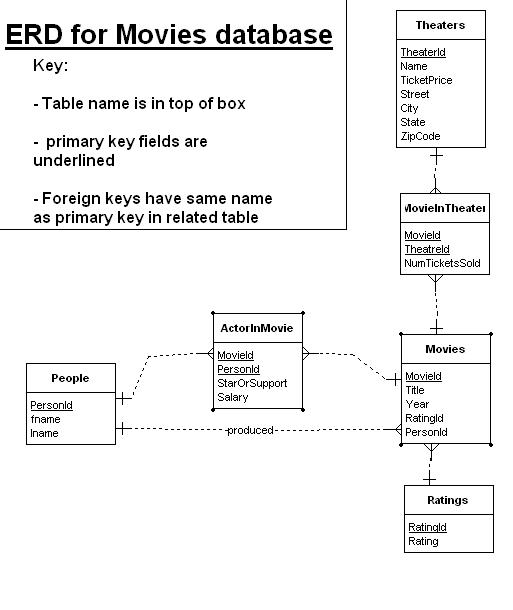
The solution below stores the actors and producers in a single table named "People". You might be tempted to create 2 different tables, one for actors and one for producers. However, this is not a good idea since it leads to duplication of data for actors who are also producers. The solution below includes an Entity Relationship Diagram(ERD) and a list of table descriptions below the ERD
If there is more than one primary key field in a table then the primary key is known as a "composite primary key" which is composed of all the primary key fields in the table.
If there is more than one foreign key field in a table then the different foreign key fields may refer to different tables.
Table Name: Movies| Field Name | Primary Key (P) Foreign Key(F) |
Related Table(s) (only enter this for foreign key fields) |
|---|---|---|
| MovieId | P | |
| Title | ||
| Year | ||
| RatingId | F | Ratings |
| Field Name | Primary Key (P) Foreign Key(F) |
Related Table(s) (only enter this for foreign key fields) |
|---|---|---|
| TheaterId | P | |
| Name | ||
| TicketPrice | ||
| Street | ||
| City | ||
| State | ||
| ZipCode |
| Field Name | Primary Key (P) Foreign Key(F) |
Related Table(s) (only enter this for foreign key fields) |
|---|---|---|
| PersonId | P | |
| Fname | ||
| Lname |
| Field Name | Primary Key (P) Foreign Key(F) |
Related Table(s) (only enter this for foreign key fields) |
|---|---|---|
| RatingId | P | |
| Rating |
| Field Name | Primary Key (P) Foreign Key(F) |
Related Table(s) (only enter this for foreign key fields) |
|---|---|---|
| MovieId | P, F1 | Movies |
| PersonId | P, F2 | People |
| StarOrSupport | ||
| Salary |
| Field Name | Primary Key (P) Foreign Key(F) |
Related Table(s) (only enter this for foreign key fields) |
|---|---|---|
| MovieId | P, F1 | Movies |
| TheaterId | P, F2 | Theaters |
| NumTicketsSold |